
On the Restoration of Japanese Gardens Abroad: From My Experience in the Restoration of the Addis Ababa Garden

MATSUNAGA Daisuke
More and more people across the world appreciate the beauty of Japanese gardens, as Misako Ito highlighted in her article in JITOW (Japan In Their Own Words) published in November 2024. Drawing on my experience involved in the restoration of a Japanese garden in Addis Ababa, Ethiopia, I urge the further enhancement of systems to support the maintenance and management of Japanese gardens abroad.
Traditionally, Japanese gardens overseas were overwhelmingly constructed in Western countries. In this sense, the Japanese garden in Addis Ababa can be considered exceptional. The appeal of Japanese culture should be communicated not only to advanced nations but also to the Global South. While manga and anime lead the charge in disseminating Japanese culture to developing countries, they are primarily accepted by younger generations. Japanese gardens, however, possess an appeal that transcends age groups. This is why I call for public support for the construction, maintenance, management, restoration, and repair of Japanese gardens overseas, including in developing countries, as part of Japan’s cultural diplomacy.
When I submitted my letter of credentials as Japan’s ambassador in March 2019, President Sahle-Work, the first-ever female Ethiopian president, asked me to restore the Japanese garden and its tea houses. The garden is within the compound of the Presidential Palace, but it was run down due to neglect over the years. Since I met with the President, I have been engaged in trial-and-error to fulfill her request. This essay will share my endeavors to restore the garden and teahouses.
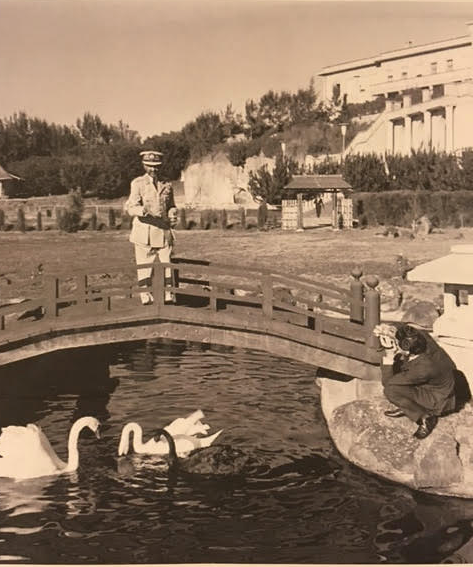
The origins of the Japanese garden in Addis Ababa date back to 1956 (Showa 31). Diplomatic relations between Japan and Ethiopia, severed during the war, were restored in 1955 (Showa 30). The following year, Emperor Haile Selassie visited Japan as its first state guest after the war. During his visit, the Emperor was captivated by the beauty of Japanese gardens. Upon returning home, he resolved to recreate that beauty within his own palace. He invited a Japanese craftsman (Mr. Hashimoto Noboru) to oversee the construction. Mr. Hashimoto spent a total of six years (1958-63) in Ethiopia, completing the Japanese garden and a tea house.
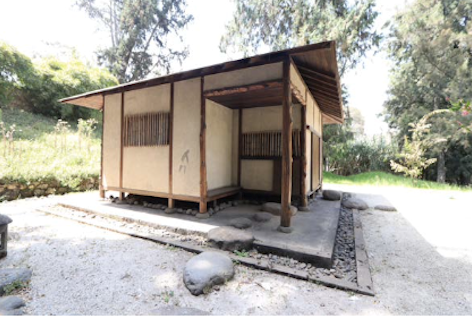
Later, in 2005, to commemorate the 50th anniversary of the restoration of diplomatic relations, the garden was expanded, and a new sukiya-style teahouse was built. A concept was introduced where the new tea house represents Japan as a tea house, while the old teahouse, completed in 1963, represents Ethiopia as a coffee house, with both meeting on a bridge.
1.Exploring Restoration of the Garden and Tea House
I initially inquired with the Ministry of Foreign Affairs about using the Cultural Grant Aid program, but I received a negative response. The explanation given was that the garden was situated within the Presidential Palace and was not accessible to the public. (In fact, the Japanese Garden later opened to the public along with the entire Jubilee Palace complex.) Fortunately, however, the Ministry of Land, Infrastructure, Transport and Tourism had a scheme to support the restoration and reconstruction of Japanese gardens overseas (“Overseas Japanese Garden Restoration Project”). After applying in fiscal year 2019, the project was approved for implementation through the end of fiscal year 2020.
For the actual restoration work under this scheme, we requested the assistance of Professor Masao Fukuhara at Osaka University of Arts, who had previously handled the restoration of the Japanese garden at Cowden Castle near my former post in Edinburgh. In August 2019, Professor Fukuhara, accompanied by his right-hand man, Professor Matsukawa, stopped in Addis Ababa on his return journey from Europe to inspect the Japanese garden and tea house. Furthermore, in September 2019, Professors Fukuhara and Matsukawa met in Tokyo with Mr. Noboru Hashimoto (then 90 years old), who had constructed the Addis Ababa Japanese Garden 60 years earlier. I, who was on a home leave at the time, also joined this meeting.
However, an unexpected obstacle lurked: the COVID-19 pandemic. The visit by Professor Fukuhara and his group had to be postponed. However, the Ministry of Land, Infrastructure, Transport and Tourism (MLIT) graciously extended the scheme’s eligibility to the following fiscal year (FY2021). Yet, in FY2021, the civil war in Ethiopia, which had been ongoing since the previous year, intensified, forcing another postponement of Professor Fukuhara’s group’s visit. Nevertheless, MLIT generously approved another extension to the subsequent fiscal year (FY2022).
2.Restoration of the Old Teahouse
The MLIT scheme itself had inherent limitations. The scheme strictly targets the reconstruction and restoration of the garden portion, excluding constructed structures. We needed to devise a way to restore the structures.
The most urgent restoration needs for the former teahouse (completed in 1963) were the wooden veranda surrounding it and the multiple pillars supporting it from below. The veranda and pillars’ wood had deteriorated over time, and the pillars were additionally severely damaged by termites, posing a risk of collapse if left unattended.
Restoring this involved addressing both (1) technical issues and (2) funding problems. Regarding the technical challenge, in February 2020, Professor Yoko Ito from the Shibaura Institute of Technology and Specially Appointed Lecturer Keita Aoshima visited with their students. They accurately measured the dimensions of both the old and new teahouses and produced detailed drawings.
Based on these drawings, through the mediation of Mr. Shinichiro Hisada, a former Japan Overseas Cooperation Volunteer, the Saeki Forestry Cooperative in Oita Prefecture and Taisei Corporation provided cedar and cypress lumber, respectively. They cut the wood precisely according to the drawings. It was decided to pre-cut the veranda and pillars in Japan and replace the old ones. Furthermore, for transporting the pre-cut timber to the site, we utilized space in containers carrying timber exported by the Forest Products Promotion Office of Oita Prefectural Government. The shipment arrived in Addis Ababa in November 2021. A local construction company, out of goodwill, stored the pre-cut timber free of charge.
Amidst this, to resolve funding issues, I launched the “Addis Ababa Japanese Garden and Tea House Revival Association” as a voluntary organization in 2021 and began fundraising. I reached out widely to those with connections to Ethiopia, appealing for cooperation. At that time, I received special consideration from the late Grand Master Sen Genshitsu of the Urasenke school of tea ceremony. The Grand Master also accepted the position of Honorary Chairman for the Revival Association.
3.The Long-Awaited Garden and Tea House Restoration Work
By fiscal year 2022, the end of the COVID-19 pandemic was in sight. Furthermore, the civil war had subsided. Based on the improved situation, Mr. Fukuhara’s team began full-scale preparations for a visit to Addis Ababa within that fiscal year. As mentioned earlier, the Ministry of Land, Infrastructure, Transport and Tourism (MLIT) scheme only covers the garden, not the buildings. On the other hand, replacing the old tea room’s wooden veranda and pillars with pre-cut timber falls under carpentry work, which constitutes building restoration and thus does not qualify for the scheme. This work was entrusted to Mr. Fukuhara’s close ally, Mr. Kiyomasa Kanamori. It was decided that the Revival Association would cover Mr. Kanamori’s travel and accommodation expenses.
Professor Fukuhara’s team stayed on-site from January 29 to February 11, 2023, to carry out the restoration work. I joined the group a week later on February 5. Our lodgings were directly behind the presidential residence, allowing us to walk to the site together every morning. Lunch was provided daily by the presidential residence.
Right in the middle of our stay (February 4–5), we held a public workshop. We taught the technique to build an outer fence using local bamboo. It was a great success, with enthusiastic participation from the general public, including architecture students.
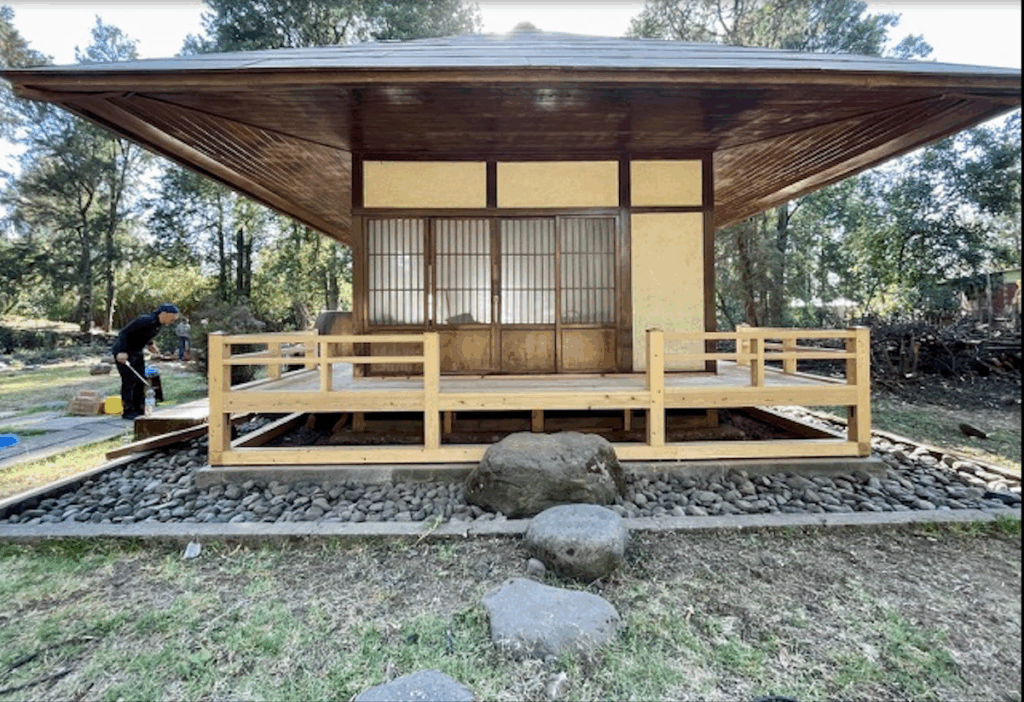
It felt like a dream to witness the decaying veranda and pillars of the old tea house, once feared to collapse, being replaced with dazzlingly beautiful pre-cut materials. Though some deformation occurred after over a year in storage, the problems were overcome through the ingenuity of the veteran architect, Mr. Kanamori. I felt proud to see the skill of Japanese craftsmen displayed so visibly.
When the stone lanterns and decorative stones were rearranged as instructed by Professor Fukuhara, they suddenly came to appear alive. It seemed as if the lanterns and stones were delighted to be returned to their rightful places.
There was also the joyful event of President Sahle-Work visiting the garden. That the President herself, who had requested the restoration of the Japanese garden and tea house, would visit the site was an unexpected stroke of good fortune for me. The President remarked, “Not many follow up on a request made during the presentation of credentials for so long.”
4.Conclusion
The Japanese garden and teahouses should be well-maintained and managed. Their original beauty should be preserved in accordance with the authentic Japanese style. After all, the site is distant from Japan and falls under the jurisdiction of the Ethiopian government. Not everything goes as expected. However, the garden possesses a quality that soothes people’s hearts, transcending nationality and culture, as evidenced by Prime Minister Abiy’s frequent visits to the site with his guests.
Addis Ababa holds another advantage: it hosts the African Union (AU) headquarters. The Japanese garden could serve as a base for introducing Japanese culture to people from various African nations. I hope the Addis Ababa Japanese Garden will play a pioneering role as a hub for promoting Japanese culture within the Global South.
――――――――――――――――――――――――――――――――
MATSUNAGA Daisuke is a professor at Osaka Gakuin University and a former Japanese ambassador to Ethiopia.